News Summary
Generated by OK AI. Editorially reviewed.
- The government has completely banned the production, import, sale, distribution and use of plastic bags thinner than 40 microns from 2078.
- Lack of adequate data, poor monitoring and lack of affordable alternatives are the main reasons for the non-implementation of plastic bag bans.
- The new guidelines have mandated producer responsibility, clear labeling on plastic bags and strictness at the source.
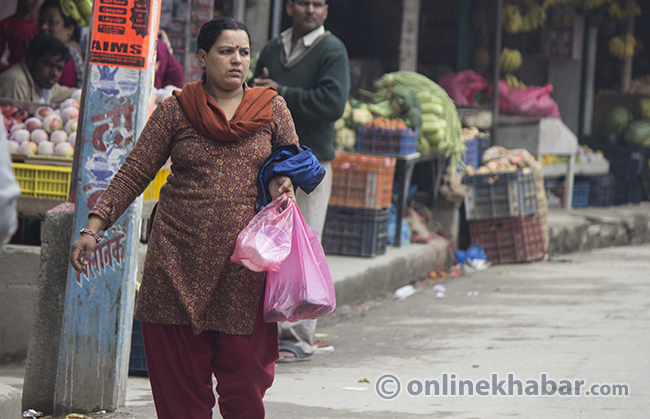
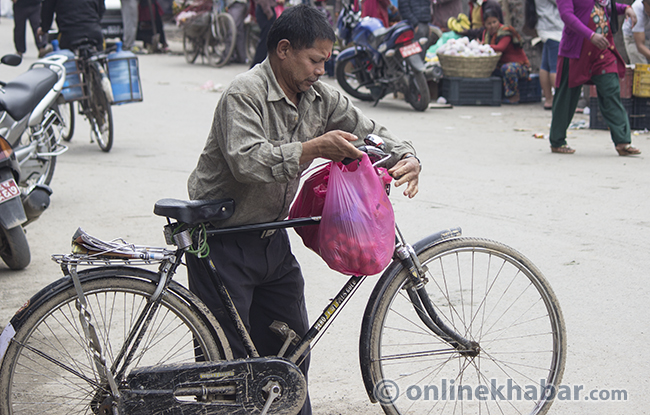
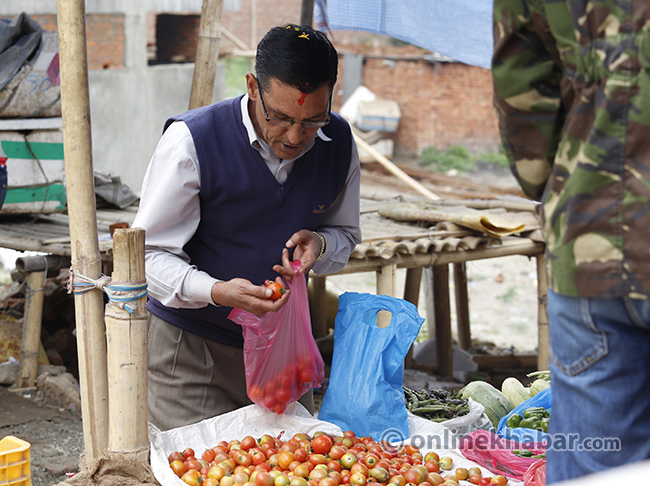
26 Chait, Kathmandu. Whether the consumer buys half a kilo of potatoes, a foot of chillies or a handful of greens, the shop gives them all three vegetables in three separate thin plastic bags. Consumers also easily hang those bags in their hands and go on their way.
This scene is very common for any city or village in Nepal. However, these thin plastic bags have been ‘illegal’ and ‘banned’ for years.
Every year on the occasion of the budget speech and environment day, the government announces the ban on plastic bags, some days the market is also monitored with pomp, small shops also pay fines for selling the banned bags. However, within a few weeks, the government mechanism slows down and the market returns to its old rhythm.
The government is not the only one to ban plastic bags, it has announced many times and it has been years since the announcement. However, it has not been implemented till date. Now the issue of banning plastic has once again come to the fore.
List of plastic bag bans
In the financial year 2078/79, the federal government announced through the budget that from 1 July 2078, the production, import, sale, distribution and use of plastic thinner than 40 microns will be completely banned.
In the announcement, it was said that cotton, jute or paper bags should be used instead of plastic bags in all commercial establishments including shopping malls and departmental stores.
It was also announced that the industry producing plastic bags or seats thinner than 40 microns will be provided with capital subsidy equal to the additional investment if the old machine parts are replaced and new ones are installed.
According to the same announcement, the government issued a notice in the gazette on 19 October 2078 and banned the production, import, sale, distribution and use of plastic bags thinner than 40 microns.
On 17 January 2078, the Council of Ministers also approved the action plan 2078 related to banning plastic bags.
The Department of Environment had said that it would tighten the control of plastic use from 1 August 2079. The department also warned that action will be taken according to the Environmental Protection Act and regulations if prohibited plastic is used or sold.
The present Prime Minister, Balendra Shah, announced in 2080 in the policy and program when he was the mayor of Kathmandu Metropolitan City – from 1st July 2080, single-use plastic will be banned, the production, sale, distribution and import of plastic flowers, as well as the use of plastic bags thinner than 40 microns will be banned in the metropolitan area and its implementation will be made effective.
This too was limited to announcements. Again, through the budget speech of the current year 2082/83, it was announced to ban the use of plastic bags less than 40 microns from 1st December 2082 to reduce environmental pollution. This announcement has not yet been implemented.
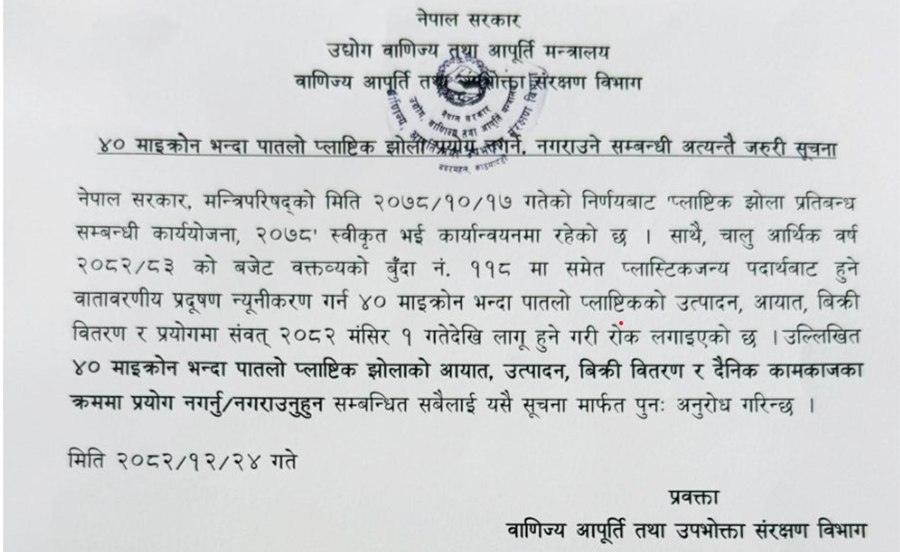
Amid several announcements and failures, the government has once again issued the ‘Plastic Bags (Regulation and Control) Directive 2082’ with strict provisions.
This new directive, brought under the Environment Protection Act 2076, is more detailed and technical than the previous announcements. However, common citizens and environmentalists have only one question in their minds – will this directive be just a ‘paper waste’ like the past or will it really make the market plastic-free?
What are the strict rules in the new guidelines?
The new guidelines have fine-tuned the thickness, size, color and responsibility of the manufacturer of plastic bags. It is clear that any plastic bag less than 40 microns in thickness cannot be produced, imported, stored, sold, distributed and used.
In the past, it was a problem to take action because it was not possible to identify the bag made by which industry in the market. To tear it, the directive has thrown the weapon of ‘transparency’. From now on, the name, address, thickness of the bag (microns) and logo of the manufacturer must be printed on the outside of each plastic bag using indelible ink in 18 to 20 font size.
Similarly, keeping human health in mind, a rule has been introduced to use transparent (natural color) bags without any color mixed in them to pack food, water and medicine, and mandatory black color bags to throw garbage (garbage bags).
The most revolutionary step is the introduction of ‘extended producer responsibility’. Under this, now the plastic industry or importer has to collect and manage at least 10 percent of the total plastic bags sent to the market and submit the annual report to the environment department.
Why plastic ban failed repeatedly?
Although the government has repeatedly announced to ban the use of plastic bags, the implementation has always failed due to serious structural and practical flaws.
Yesterday, Tuesday, the Commercial Supply and Consumer Protection Department issued a notice not to use plastic again. But due to lack of preparedness, lack of reliable data of industries, lack of cheap alternatives and weak monitoring mechanism, this announcement has increased the risk of being limited to paper like the previous 9-10 announcements.
The main reason why the plastic ban is not effective is that the government does not even have general information about the producers. Savit Deshar, Environment Inspector of the Environment Department under the Ministry of Forests and Environment, says that the regulatory body does not have a ‘database’ of sufficient manpower and industries.
“We don’t have accurate data on where and how many industries are there to monitor. We only have data on 14-15 industries in Kathmandu Valley,” Deshar said.
In the absence of sufficient data, government monitoring has always become like a ‘seasonal instrument’. Plastic supply in the market has not been stopped because instead of reaching the monitoring source i.e. the industry, the only thing to do is to take away the bags on the streets for a few days and harass the small grocers.
According to Deshar, even though it was decided to ban bags thinner than 40 microns, the government failed in the managerial aspect.
He said, “It did not work whether to give subsidies to replace the machine (dye) or to provide technical assistance to the bag making industries according to the standards.”
In addition, the market was not ready to adopt expensive alternatives when the government did not bring any financial package to make paper, jute or cloth bags available instead of plastic, which is cheap for traders and free for consumers.
Open borders have added another big challenge while the internal management is in shambles. Despite attempts to tighten the policy in the country, the illegal entry of cotton and thin plastic bags through the open border with India continues overnight.
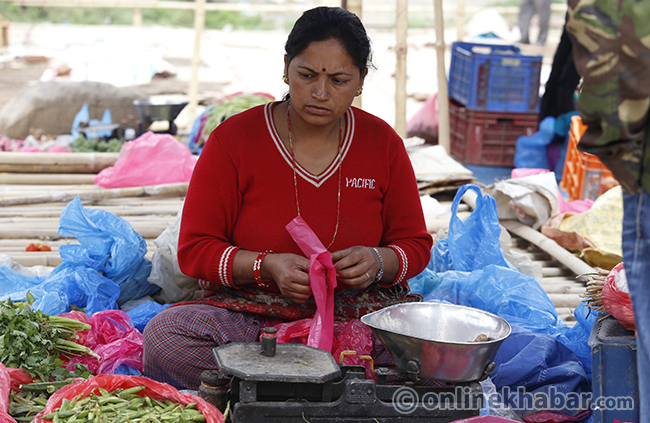
In the absence of strictness at the customs points, the domestic policy has become completely meaningless. On top of that, ‘Don’t give me a bag!’ The consumer’s habit has forced the traders to keep plastic even if it is hidden. As the consumer’s habit of carrying a bag from home to the market has not improved, the practical side of the plastic ban has become even weaker.
Even the Supreme Court, showing interest in this matter, has demanded a detailed report from the Ministry of Industry, Commerce and Supply and the plastic industry after the attempts to ban have failed continuously.
The court has ordered the industrialists to explain why they have to use plastic and what are its standards and alternatives.
According to Inspector Deshar, now the Ministry is studying this matter in accordance with the provisions of the ‘Basel Convention’.
How to implement it?
Experts say that the government and the stakeholders must take strategic steps to put Directive 2082 into practice. They are also warning about the serious effects of plastic on the environment and human health.
Environmentalist Manjit Dhakal says that in order to make the regulation of plastic bags successful, it is not necessary to look for it in the market only, and it should be tightened at the point of production and import (source).
“Plastic is a type of petroleum product, the smoke released by burning it has a serious impact on the atmosphere and when it is thrown away, it has a serious impact on water sources,” says Dhakal, “currently, the latest studies have shown that even the food we eat has started mixing plastic particles (microplastic), it is having a very serious impact on human health.”
He stressed on the need to explain to the citizens that the ban only applies to ‘single use’ plastics below 40 microns which cannot be recycled and not sealed.
In spite of such a serious risk, Dhakal concluded that the style of monitoring is wrong because bag control is not effective.
He said that plastic control should be carried out in a professional manner and not on the vegetable sellers in the market, but the monitoring wire should be on the plastic manufacturing industry and the customs point of import.
Environmentalists say that the industry should take a ‘digital thickness meter’ to embody his statement that there should be strictness in the estuary.
They suggest that the technical team should be active to check whether the description of micron printed on the bag by the industrialist is true.
Stakeholders say that the policy of controlling the source itself as well as the expanded producer responsibility should also be strictly audited.
The government should have the courage to cancel the license of the industry that does not show a transparent account of how many tons of plastic was produced by the industry and how 10 percent of the waste was brought back.
It is equally important to strengthen the local level in this campaign. Environmentalist Dhakal said that the practice of classifying waste into decomposable and non-decomposable and reusing (recycling) should be at the municipal level.
Since the local government is responsible for enforcing the law of the lion court in the villages and towns, it seems that the local level should develop the system of monitoring and imposing fines on the shops within their area.
The most important thing to put the guidelines into practice is to encourage alternative industries. The experts suggest that the government should give customs exemptions, loans at low interest rates and tax concessions to the industries that produce cloth, jute, paper or biodegradable (biodegradable) bags.
Increasing the micron does not reduce the waste
The Nepal Plastic Manufacturers Association has claimed that the government’s decision to ban plastic bags thinner than 40 microns is unreasonable, discriminatory and unprepared.
The association says that environmental problems will not be solved by simply increasing the thickness of plastic (microns) without making a solid policy for waste management.
Santosh Sedhain, vice president of the association, objected to the fact that the government agencies are making false statements that there is no thin plastic recycling (reprocessing).
“The comment that has been created in the public that thin plastic is not recycled is completely wrong, regardless of whether it is 10 micron, 5 micron or 2 micron, even thin plastic is recycled,” Vice President Sedhain said.
According to the association, the industrialists who had invested crores of rupees and installed the machines when the standard was 20 microns were suddenly forced to go to 40 microns. Sedhai complains that the subsidy provided by the government is limited to paper when the parts of the machine need to be changed.
“The government’s attention went only to the empty bags made by the indigenous industry, but the plastic used in the packaging of shoes, clothes, noodles, biscuits and other foods imported from abroad is very thin. Why is the government silent on this?” asked Sedhain, “We are only targeting the indigenous industry, this is a biased policy.”
According to the association, about 80 percent of the plastic industry has been closed due to the tendency to blame the industrialists for continuous political instability and poor management.
“We have not said that we don’t follow the government’s rules, but the government had to assume guardianship and understand the problem,” Sedhain said.