News Summary
Generated by OK AI. Editorially reviewed.
- With the formation of the new government, industrialists and businessmen are expecting policy stability and easy business environment.
- The industrialists demand that the government should remove procedural complications and implement a one-door system.
- Raghunandan Maru has submitted his candidacy for the new leadership as the elections of Federation of Nepal Chamber of Commerce and Industry are approaching.
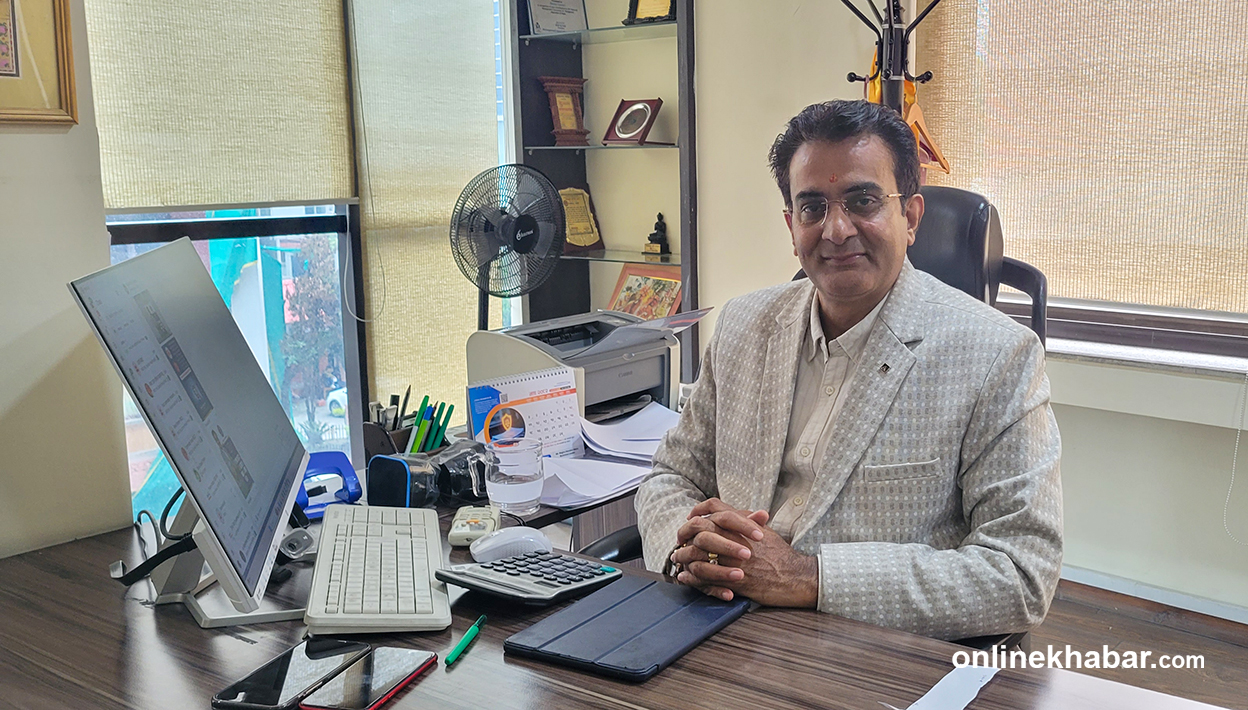
With the formation of the new government, there has been a communication of hope in the commercial sector. The business world believes that especially due to political stability, there will be policy stability and it will help in economic development. On the other hand, the Ministry of Finance is preparing a new budget. At the same time, the Nepal Federation of Commerce and Industry is also in the midst of an election. The managing director of Shivam Cement, who is also the president of the Cement Producers Association, is focused in this context Raghunandan Maruwith Online newsConversations with:
With the formation of the new government, how are the industrialists and businessmen feeling?
Now two-thirds of the country has a strong government. The industrialists and businessmen are welcoming it wholeheartedly. We are excited not only as industrialists, but also as citizens. Because, until recently, the creation of a ‘livable’ environment within the country, an environment that is easy to do business within the country, which was limited to the past, is now expected to be implemented in practice. We hope that the situation that we were all worried about yesterday will disappear now.
What are the solid expectations of industrialists and businessmen with the permanent government?
Policy stability is the main expectation. We want a solid policy that should be long-term. This is a very important aspect for an investor. Whoever invests, he wants assurance that the investment is safe. We have some examples of this. Our group also invited investors from outside. They studied here. Then their conclusion was that there is no single policy here, one government leaves, another government comes. When a new government comes, the policy changes. Therefore, policy stability is the biggest expectation.
There are many procedural complications in the process of doing the second job. From registration of the company to every stage of operation, the same problem has to be faced. Unwanted inconvenience from licensing should be removed now. I say, Nirmul must be done. Because now is the time to build a country. Even at this time, if the problem is not removed, it will always create a difficult situation to work.
Another issue is that the licensing process of the industry should be simplified. If the application is not received after completing the legal process, it will not be accepted. However, there is unnecessary hanging on the applications that have completed the process. The trend of moving files from one place to another should be improved.
Another problem is forest tenure. Due to forest encroachment, hydropower, mining and other sectors have been badly affected. The unreasonable process of usufructuary rights should be removed. Forests should be protected, there are no two opinions on that. For that, if the law says to cut 10 trees, bring a rule to plant 50 trees instead of 10. However, remove the procedural hassle. It is expected that due to usufructuary, hydropower and mining industries are the most affected.
The subject of limitation has also become a challenge today. If we want to create an economy of 100 trillion, industry and business must flourish. For that, it is necessary to create a comfortable environment for the establishment of large industries. The government should be a little more generous and address such issues. Large-scale industries require an equally large investment. It creates employment and contributes to capital development, only then the size of the country’s economy expands. In this way, if large industries and investors are to enter the country, then the state must create a comfortable environment under the provisions of restrictions.
In terms of restrictions, work should be done through a one-door system. For example, if a mining industry says it wants 1200 ropani land, the state should set the same limit for it. If the industry fails for some reason, you can make a rule that you can sell the land but not use the land for plotting or other purposes. However, the process should be easy. The long hassle and process of the Ministry of Land Reforms will have to be made investment friendly. Let’s eliminate the tendency to search for recommendation after recommendation and keep moving files.
Then every work is easy to do in one-door system?
That’s right. Even in today’s information technology era, you are sitting passing files from one table to another table, how can we make leaps and bounds with this kind of work style? File from this table to that table, comments from that table. Now this comment and order practice should end. Today, what is the status of which file, everything can be seen at a glance from the computer. A system can be made so that files can be viewed by offices, departments and ministries at once. From that, you can create a facility that can work. Now government work should be fully technological. Must go for paperless detention. If they can do that, the country will turn around during the current government.
The RSVP said in its pledge that the old laws would be repealed. Finance Minister Dr. Swarnim Wagle also formed a committee by giving priority to that matter. How has the industry taken it?
This is a very big step. We are very optimistic. This topic was also mentioned in the report of the High Level Economic Reforms Suggestion Commission led by the outgoing Finance Minister Rameshwar Khanal. He has already said that some unnecessary laws and regulations should be repealed. It should be followed literally. Laws should be developed according to time. The hassles of rules and laws should be removed. If that happens, change in the country will be possible quickly.
Currently, the per capita income is around 1500 US dollars, the current government’s goal is to increase it to around 3000 within five years. Do you see it as possible?
The speed at which youth migration is happening now must be stopped. There is a feeling of despair in the youth now. It should be removed immediately. This work can be done by the current government. They should not only be inspired to do business in Nepal, but also create that environment. The state should be flexible to some extent for doing business in Nepal, establishing industries and small and medium businesses. They should be encouraged in everything from startup loans. As young people start entrepreneurship, it starts showing positive effects in every sector of the state. In that case, making 1500 to 3000 dollars is not a big deal. Now, young people are going to Gulf countries for employment. This is having a very big negative impact on the social structure. So the government should be serious about it. The country should not run on remittances. The economy runs on domestic production. We are exporting manpower and importing goods. Here it is the opposite.
Is your intention to grow young entrepreneurs?
Certainly, if we are to build a $3,000 per capita income and a $100 billion economy, we must turn the youth into entrepreneurs. If you work with good vision and good thinking, it will not take much time to build a country. Within some time, Nepal may turn into a donor nation.
Currently, the concerned bodies are preparing the budget for the next financial year. What do entrepreneurs want to be included in the tax policy?
There is a need for some revision in the tax policies. When it comes to Value Added Tax (VAT) in India, GST has a slab concept. There is a slab of 18-19 percent by taking 5 percent. Now we should not be tied to 13 percent. Low tax in essential areas and high rate of VAT on luxury goods should be applied. Tax policy should be practical.
Do you think there should be a specific tax rate?
For the Nepali people, which are essential items, for example, food. It should be reviewed so that the lower value added tax is applied. People can be relieved from high prices of consumer goods. The tax rate can be different for expensive and luxury items.
What is the current state of the cement industry?
Now the cement industry has reached an export-oriented level. Production capacity is sufficient. However, it is not possible to export. In the past, the government used to give 5 to 8 percent subsidy to cement industries for exporting. However, the industrialist did not get that subsidy. Now the subsidy is stopped. The current government should continue to give subsidies. Because, if more revenue is raised from cement than subsidy, why is the state not understanding that? There is no loss for the government. Today, Nepal has a production capacity of about 20 million tons. The consumption has not increased beyond 8 million tons. So now we have more production capacity. Exports should be encouraged to utilize this potential.
The price of cement has increased, why has this happened?
The price of cement has increased a bit now. The main reason for this is the shipping cost. The price of diesel has increased. The production price has increased. Sack and packing cost is also continuously increasing. The prices of other raw materials including plastic have increased. Goods that can be bought for 910 thousand dollars yesterday have reached 1600 dollars today.
Has the Iran-US war affected it?
It is difficult to predict the impact of war. It is certain that it is causing multifaceted effects. We hope it ends soon.
Do you have any expectations of the cement industry with the new government?
Limitation is very important. The subject of forest rights is also in our expectation. Our demand is that the system of usufructuary rights should be removed. If you have to cut one tree, the division forest office gives permission, but if you have to cut two trees, you have to go to the cabinet. Why is this rule made? Such laws and regulations should be amended and removed. A 1 billion dollar economy will not be built until the mining industry flourishes. Currently, the mining industry contributes only 0.5 percent to Nepal’s GDP. China has a contribution of 7 percent. If we also want to increase the contribution of the mining industry to the GDP, we must improve the complicated laws and regulations.
Now the government is imposing green tax on coal import. Green tax should be removed. There is no reason to impose tax on goods which are not produced in Nepal. Also, if the procedural complexity is removed, the country can benefit greatly through the cement industry.
Another issue should be the increase in government spending. In that too, capital expenditure should be increased. It also increases the consumption of cement. Government expenditure of current nature should be reduced while increasing capital expenditure. A large budget goes to the province. It is also heard that the provincial structure should be reviewed. However, there is also a need for reform in government spending.
Is cement being exported now or is it closed?
Now it is almost closed. A few industries in border areas are doing it. After subsidy reduction, it becomes difficult to compete with India. The state should give concessions to be competitive in price.
What are the possibilities you see for the rapid development of the country?
Infrastructure is the main means to develop the country at a high speed. Nepal is geographically a small country. However, today it takes at least 14/15 hours to reach Humla from Nepalgunj. Humla is an area where herbs are mined, its market potential is in Nepalgunj. After that, the attention of the state should now go to how to easily connect these areas. The state should invest maximum in infrastructure. Create an environment where you can reach Biratnagar from Taplejung in two hours, it will transform the economy.
What should be done in the next budget to ensure that ‘investors have an investment-friendly environment in Nepal’?
One-door system should be made mandatory in government services. In the past, UML, Congress and Maoists also prioritized it in their slogans. Not applied in practice. Now it should be applied in practice. Businessmen have been wandering around for three or three years for some license. It should be improved. Licensing process should be fast. The budget should come in such a way as to win the confidence of the investors to guarantee the investment.
What are your preparations for the upcoming elections of the Federation of Nepal Chamber of Commerce and Industry?
Elections of Federation of Nepal Chamber of Commerce and Industry are approaching. This year, I have submitted my candidacy for the position of working committee member from the panel of Shiv Ghimireji, dedicated and supported by Anjan Shrestha. The Federation is an institution with a great responsibility. It should be conducted in a responsible manner. When the federation is strong, it can contribute responsibly to the prosperity of the country. I have given my candidacy to operate that platform properly.
What is your agenda?
Even today, I feel that there is a gap between the government and the federation. That distance has to be removed. The federation should also show the way to guide the government towards digitization. I feel that we are wrong in this. I express my commitment to work on this. There is still a lot of disappointment among industrialists and businessmen. That will be my role.
We want to run the federation in a new way. Investors, industrialists and the government all have a positive outlook. The atmosphere of mistrust towards the private sector should be removed. The investment environment is shaky. When we win, the industrialists and businessmen will feel that there is an investment environment for businessmen.
In the end, if you have missed something that needs to be said, you can keep it.
RSVP has written many things in its manifesto. I think there is no doubt that the country will turn its back if this is followed literally. Now the time has come, the Nepali people should have full faith in the government and the Nepali businessmen should have full faith and decide to do something in the country, to do business, to build the country. It is possible to build a country if we think about how we can drive the country to fulfill that need, how we can grow in our respective areas.