18 Chait, Kathmandu. After suffering a bitter defeat in the February 21 election, the Madhesh parties have prepared for party unity and handing over the leadership to the young generation.
The leader of Janata Samajwadi Party (JSP), Nepal, Hradayesh Tripathi informed that preparations are being made for unification between the Madhesh parties.
Leaders say that after the first time since 2048, there was no representation in the House of Representatives, not only the unity of the party but also the formation of a new kind of party.
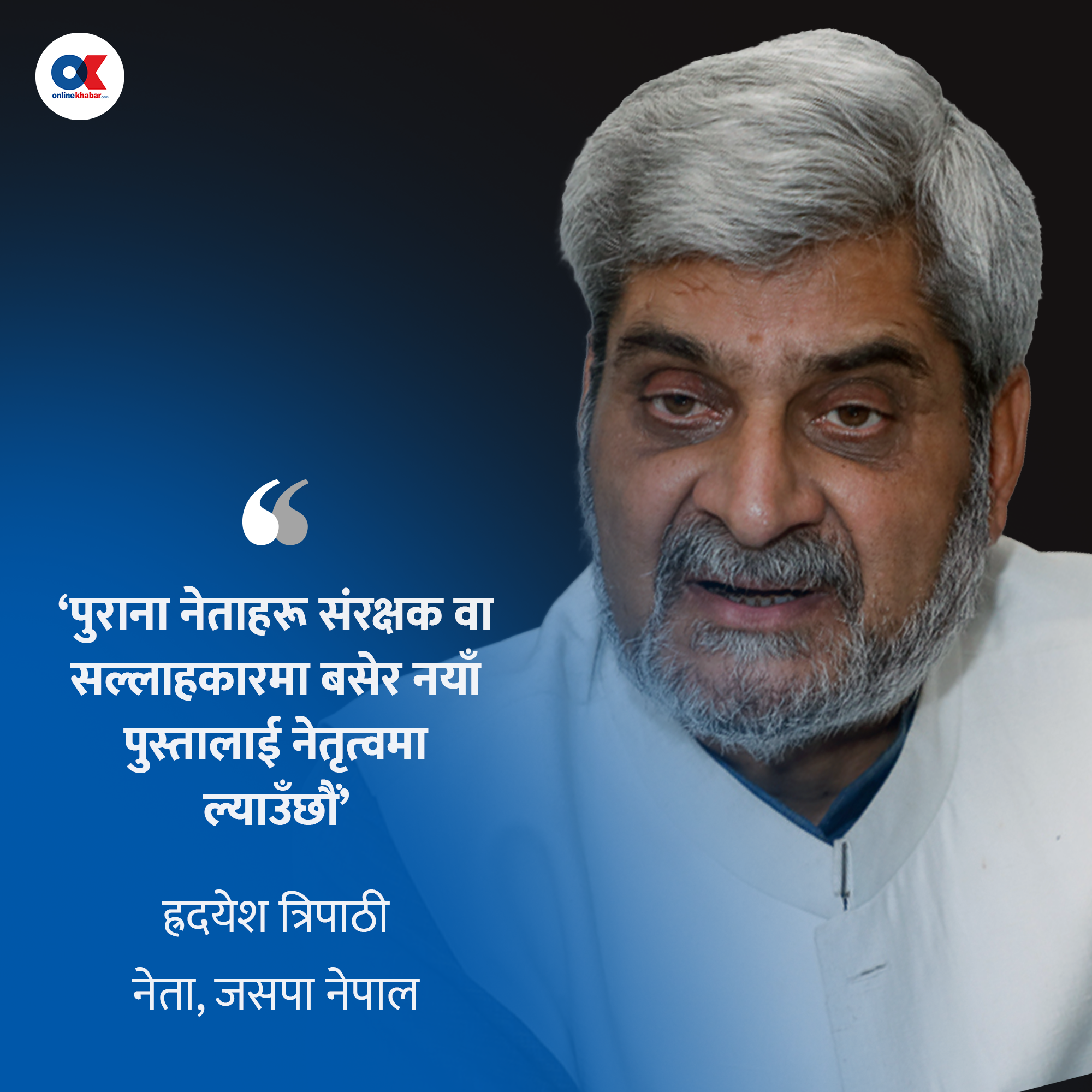
‘Discussions are going on to advance the party in a new way. Old leaders sit in the role of protectors or advisors and bring the leadership of the new generation,’ said Tripathi, who is also a former minister, to Online News.
Tripathi said that although there is a kind of consensus on handing over the leadership to the young generation, the matter of who will be made the leader has not been finalized.
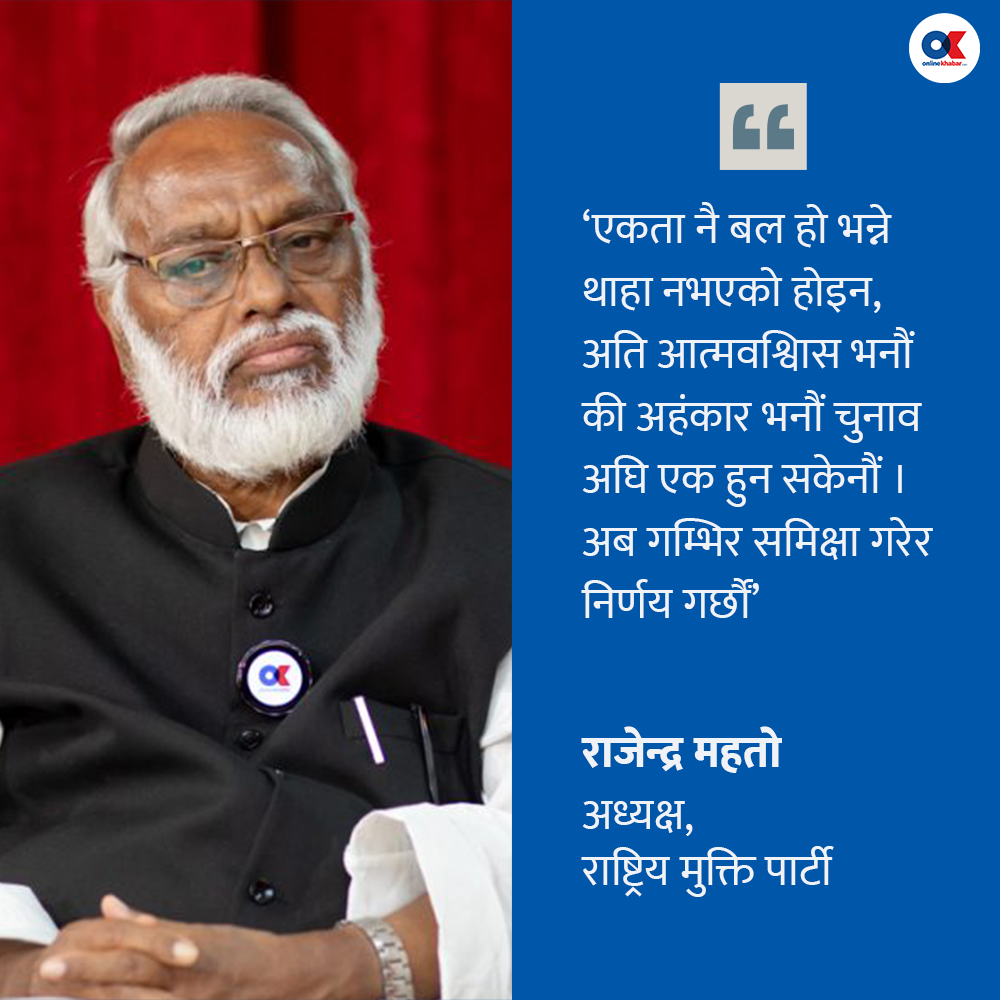
Rashtriya Mukti Party (RAMUPA) Nepal President Rajendra Mahato said that a decision on integration will be taken after a serious discussion.
He says, ‘It’s not that we don’t know that unity is strength, but we could not unite before the elections because of overconfidence or arrogance. Now we will make a decision after a serious review.’
A lost opportunity
In the elections last February, the Rashtriya Swatantra Party (RASWPA) won in 30 out of 32 regions of Madhesh province. Raswap became the first party in Madhesh with 1.3 million votes, Jaspa Nepal was fourth with 1.38 thousand votes and Janmat Party with 50 thousand votes fell to fifth place.
If we add the votes received by all the Madhesh parties from all over the country, it is three and a half lakh. This is more than three percent of the total votes cast this time. This shows that if the Madhesh party was united, representation in the House of Representatives was possible.
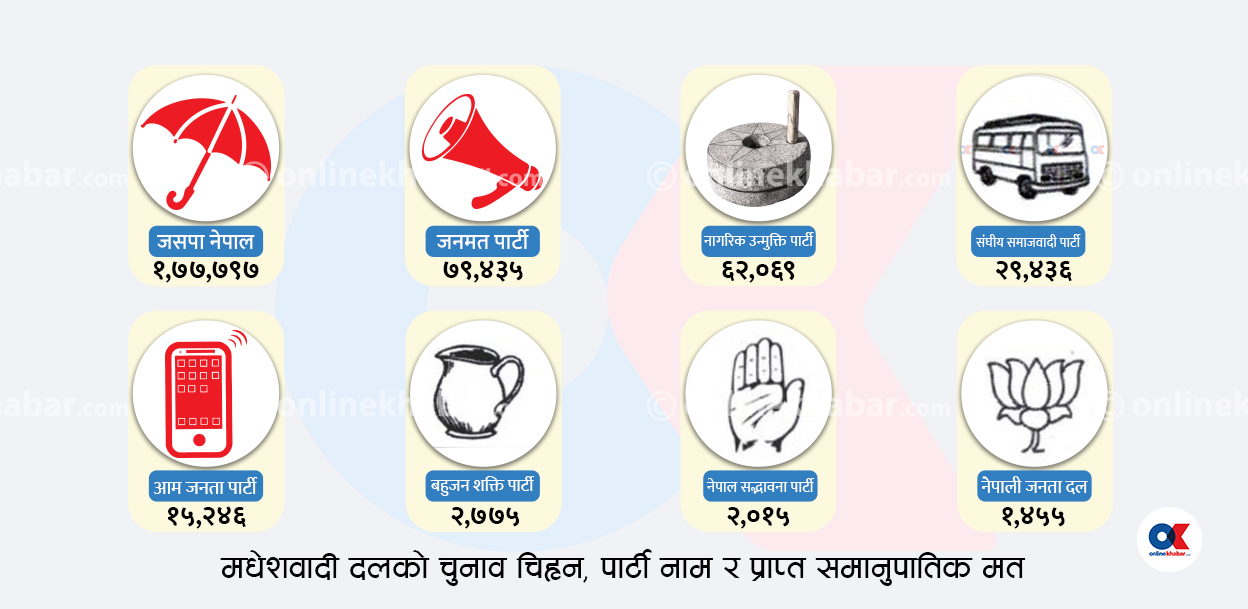
Jaspa Nepal got 177 thousand 797 votes and Janmat Party got 79 thousand 435 votes. Rajendra Mahato’s Ramupa, Ashok Rai’s Jaspa and Resham Chaudhary’s Citizen Liberation Party, which went to the election with a single symbol, got 62 thousand 69 votes.
The Nepal Federal Samajwadi Party, which fought with a single symbol, got 29,436 votes. NSSP President Mohammad Rizwan Ansari said that the leaders of various parties are discussing unity or a front strike.
He says, ‘I have put forward a proposal to the leaders to go through self-examination, proposals have also come from them.’
Unity in struggle and crisis
On May 8, 2077, the government amended the Political Parties Act, 2073 through an ordinance. The government had brought an ordinance to relax the provisions requiring 40 percent of the central committee and federal parliament to dissolve the party.
In order to get the recognition of the divided party in the ordinance, a provision was made to reach 40 percent in one of the central committee or the federal parliament. However, no party was divided using the ‘concession’ given by this ordinance.
The ordinance had the opposite effect. Two days after the promulgation of this ordinance, two Madhesh parties, the Samajwadi Party (SP) and the Rashtriya Janata Party (RJP), merged.
Mahindra Rai Yadav, one of the leaders who signed the agreement from RJP at that time, remembers, the government tried to split the Samajwadi Party by bringing an ordinance, we united the two parties.
Yadav is now in the Nepali Communist Party.
At that time, Mahant Thakur, Rajendra Mahato, Mahindra Rai Yadav, Saratsingh Bhandari from Rajpa and Baburam Bhattarai, Upendra Yadav, Ashok Rai and Rajendra Shrestha from SP signed the agreement.
Another example of how the Madhesh party will come together when there is a crisis is the unity between the five parties in Baisakh 2074. The Madhesi Morcha took a stand of not participating in the local elections announced for 31 Baisakh.
On 7th Baisakh 2074, Terai Madhesh Democratic Party led by Mahanth Thakur, Sadbhavana Party of Rajendra Mahato, Rashtrayi Madhesh Samajwadi Party of Sharatsingh Bhandari, Terai Madhesh Samajwadi Party of Mahandri Rai Yadav and Madheshi People’s Empowerment Forum (Republican) of Rajkishore Yadav formed Rajpa.
After party unity, RJPA took part in local elections and got good results. Rajpa won 14 municipalities and 11 municipality heads. It also became a national party by participating in the general election that year. In the 2074 election, the Rajpa got 4 lakh 72 thousand 254 votes on the proportional side and won only 11 seats directly.
Pressure from workers for unity
Gajendra Narayan Singh established the Nepal Sadbhavana Party by giving prominence to the Madhesh issue. After 2064 Madheshi Janadhikhar Forum and Tarai Madhesh Lokantrakki Party became strong Madheshi parties.
By 2082, none of the Madhesh party could get three percent of votes. Mahant Thakur, Patron of Jaspa Nepal and Member of the National Assembly, says that informal discussions are continuing in the meeting of the Madhesi Morcha.
Jaspa Nepal leader Manish Kumar Suman says that there has been pressure from local leaders and activists for unity. He has the experience of getting similar sentiments not only from his own party but also from other party workers.
Leader Suman says, ‘Even before the election, we have united with some parties. After reviewing the election, we will initiate unity with more parties.’