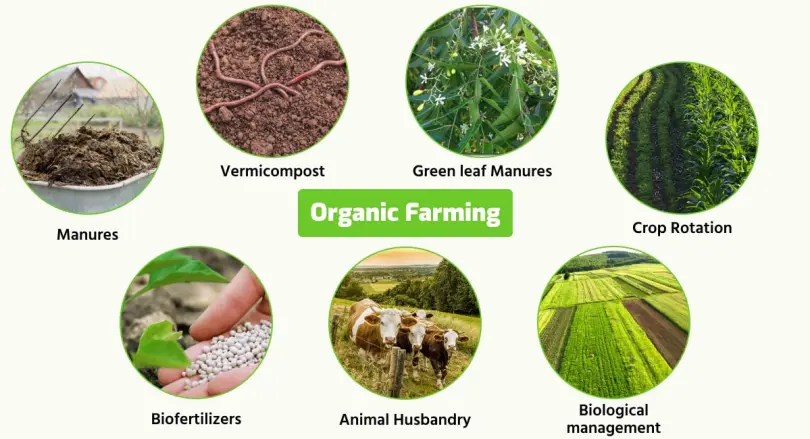
Organic farming is a natural and sustainable method of agriculture that avoids synthetic chemicals and promotes healthy soil, eco-friendly practices, and high-quality crop production for a better environment and healthier lifestyle.
Organic farming is a sustainable agricultural method that focuses on producing food using natural methods and ecological balance by avoiding the use of synthetic fertilizers, chemical pesticides, genetically modified organisms (GMOs), and artificial growth regulators, relying instead on organic inputs such as compost, green manure, and biological pest control. This approach promotes soil health, biodiversity, and environmental protection, ensuring long-term agricultural productivity.
In this, we work in harmony with nature by enhancing natural soil fertility and ecosystem stability. The system emphasizes the use of renewable resources, conservation of water, and maintenance of ecological balance. By adopting organic practices safe and nutritious food can be produced and also reduce pollution and protect natural resources.
Overall, it represents a holistic approach to agriculture, where the focus is on sustainability, health, and environmental responsibility, making it an essential method for the future of global food production.
Before the 20th century, agriculture worldwide was largely natural and traditional, relying on crop rotation, animal manure, and compost. There was no concept of “organic” farming as such, because all farming was essentially organic by default.
The modern organic movement began in 1924, when Rudolf Steiner delivered a series of lectures in Germany.
In the 1930s and 1940s, Sir Albert Howard played a crucial role in shaping organic agriculture.
In 1940, Lord Northbourne introduced the term “organic farming” in his book “Look to the Land.”
In 1972, the International Federation of Organic Agriculture Movements (IFOAM) was established.
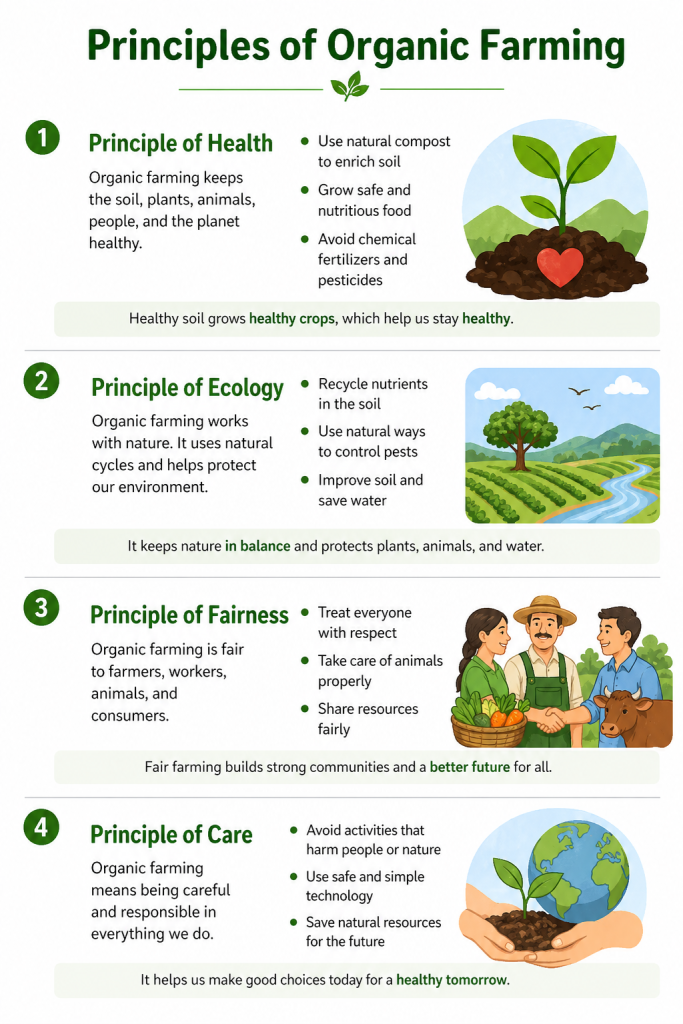
According to International Federation of Organic Agriculture Movements (IFOAM) , organic farming is guided by a set of core principles that ensure agriculture remains sustainable, environmentally friendly, and socially responsible. These principles were formally established by the IFOAM
The principle of health states that organic farming should sustain and enhance the health of soil, plants, animals, humans, and the planet as one interconnected system.
Healthy soil leads to healthy crops, which ultimately ensures better human health.
The principle of ecology emphasizes that farming should be based on living ecological systems and natural cycles.
It works in harmony with nature, not against it. It protects biodiversity, conserves water, and maintains ecological balance.
The principle of fairness focuses on equity, respect, and justice for all living beings involved in agriculture.
This principle promotes a socially responsible farming system that benefits everyone.
The principle of care highlights the importance of precaution and responsibility in farming practices.
This principle ensures that decisions in organic agriculture are made with long-term environmental and social impacts in mind.
It protects the environment by avoiding harmful chemical fertilizers and pesticides. It improves soil fertility naturally, reduces soil erosion, and helps maintain biodiversity. It also supports cleaner air and water by reducing pollution.
Organic food is free from synthetic chemicals and pesticides, making it safer for consumption. It is often richer in nutrients and antioxidants, which supports better long-term health and reduces risks of diseases caused by chemical exposure.
Although initial farming may require effort, organic farming can be more profitable in the long run. Organic products often have higher market value, lower input costs (since chemical fertilizers are avoided), and increasing demand in both local and global markets.
| Organic Farming | Conventional Farming |
|---|---|
| Uses natural inputs | Uses chemical fertilizers and pesticides |
| Environment-friendly | Can harm soil and environment |
| Improves soil health | May reduce soil fertility over time |
| Safer food | May contain chemical residues |
| Lower yield (sometimes) | Higher yield |
Organic farming is a safe and eco-friendly way of agriculture.
It improves soil health, protects the environment, and provides healthy food.
Although it has some challenges, it is a good solution for sustainable farming in the future.
Explore more on Home page
Learn about Trichoderma viride
****** Thank you ******