News Summary
Generated by OK AI. Editorially reviewed.
- The new House of Representatives held its first meeting on March 20 and recalled the duties of the new government and parliament.
- The government has planned to frame the Federal Civil Service Bill within 45 days and free the administration from political interference.
- A decade after the promulgation of the Constitution, federal laws, police adjustment and education bills have not been made.
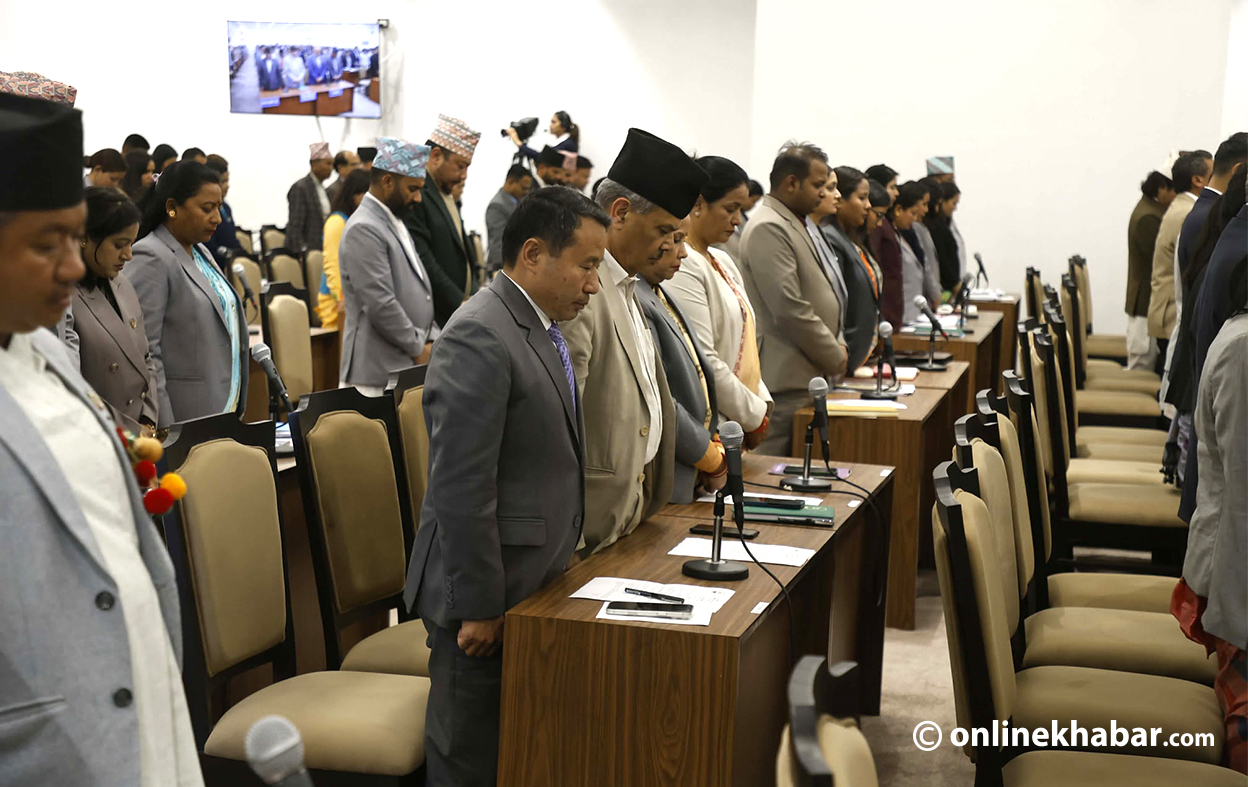
20 March, Kathmandu. According to the election mandate, the new government and the House of Representatives have started their work. The first meeting of the new House of Representatives was held on Thursday. Where the parliamentarians also remembered the new government and the duties of the parliament.
“The new parliament has not only the achievements of yesterday, but also the responsibilities of yesterday,” Varshman Pun, the leader of the Nepali Communist Party (NCP), said, “There are peace agreements that have not been completed due to various reasons, and the issues of transitional justice after that.” The new government will take ownership of this too.’
It has been two decades since the peace process started in the country. But transitional justice has not been completed. The issue of the conflict period is still in confusion. The victims of the conflict have not received justice.
After the dissolution of the House of Representatives enacted the Act on Investigation, Truth and Reconciliation Commission for Disappeared Persons, the work has progressed with the formation of the Commission. Now the responsibility of finalizing transitional justice has shifted to the new parliament.
It is not just a matter of transitional justice. The new parliament has to do many things that were widely discussed in the previous parliament but could not reach a conclusion.
Even after a decade of the promulgation of the Constitution, the federal laws necessary to implement the Constitution have not been enacted. Issues such as personnel structure of the three levels of government, police management, and financial authority are in controversy and confusion due to the absence of federal laws.
Civil Act preferably
The government has also set a deadline for which subjects to prioritize. According to which, the Federal Civil Code will be enacted within 45 days.
In the 100-point government reform agenda, the government has said that it will draft the Federal Civil Service Bill within 45 days.
The aim of the government is to free the public administration from political interference and make it fair, neutral and accountable to the citizens. For this purpose, it is said that civil servants, teachers, professors and all national servants should be free from direct or indirect affiliation with any party, group or interest center.
Otherwise, the government is preparing to bring a civil bill with provisions for taking departmental action strictly according to the existing law. In addition, the government aims to make the decision-making process and service delivery effective by abolishing the party trade union in the public administration and putting an end to unwanted interference and informal pressure.
It is said that the necessary legal provisions for this will be made especially in the Federal Civil Service Bill and this bill will be formulated within 45 days.
The constitution says that all three levels will have their own employees. However, the Federal Civil Bill has not been made. As a result, administrative federalism has not been implemented.
The main work of staff adjustment was done within the previous term of the previous House of Representatives. But there was no result in matters such as the recruitment of employees at the union, state and local levels, the jurisdiction and which level they will be under. Provincial public service commissions have been established by the constitution. However, even now, there are employees under the union at the local level and state.
The Chief Secretary of the Province, the Secretary of the Ministry of the Province and the Chief Administrative Officer and Accounts Officer of the local level should be subordinate to the Union. This responsibility has shifted to the new parliament.
The Police Act was enacted, but not adjusted
The country has been in a federal system of government for a decade and has not been able to move to a federal system – the security agencies. The issue of how long the security agency will remain under which level was always discussed in the previous parliament, but it could not be implemented. As a result, they could not become a provincial security agency. Even now, there is a security mechanism in the country according to the centralized governance system.
Two laws related to police adjustment have already been made in 2076. ‘Bill made to make arrangements for the adjustment of police personnel in Nepal Police and Provincial Police’ was approved by the President on 28th January 2076.
The ‘Bill made to regulate the operation supervision and coordination of the work performed by the Nepal Police and State Police’ was also approved by the President on 28th January 2076.
The Organization and Management Survey (O&M) necessary to adjust the police has been approved by the Council of Ministers after the Act on the work of the federal police and the state police has been enacted through police adjustment.
According to the Organization and Management Survey (O&M) approved by the Council of Ministers in November 2077, 24 thousand 816 personnel should be adjusted in the Central Police and 54 thousand 720 personnel in seven provinces. But the police adjustment work has not started yet.
Education in Civic Interest Act
Another law that common citizens expect from the new government is the Education Bill. The constitution has delegated authority in education to the three levels of government. Accordingly, the Federal Education Act has not been made.
The new government has not said anything on this matter either. There was a lot of debate on this matter in the dissolved House of Representatives. When the bill was in the final stages of being passed, it was stopped when the House of Representatives was dissolved. This work has to be done by the new parliament.
The then government introduced the School Education Bill on 27 August 2080. The bill was discussed in the parliamentary committee and progressed. It was passed by the parliamentary committee and submitted to the House of Representatives on August 6, 2082. But could not go further than that.
As a result, the local level has not been able to use their rights in education. The constitution has placed education up to the secondary level under the sole authority of the local government.
The list of single rights of local government is in Schedule-8 of the Constitution. Where basic and secondary education is mentioned. On this basis, the entire right of education up to the secondary level is the jurisdiction of the local level.
In the dissolved House of Representatives, the RSVP argued that education should be made useful for life. On August 6, 2082, when the school education bill was passed by the parliamentary committee, the RSVP had 3 points of difference. One of the topics was that those who work in child development should be considered as teachers.
In the Compulsory and Free Education Act made in the year 2075, institutional schools have set the percentage as 10, 12 and 15 percent based on the number of students. However, except for some institutional schools and Kathmandu Metropolitan City, it has not been implemented until it is strictly implemented. Even on this issue, RSVP had a different opinion and said that scholarship should be explained in the report of the school education bill.
‘We all have seen the practice of charging lab fees, library fees, food fees, sports fees, additional fees until the definition of a full scholarship is established,’ Sumana Shrestha, the then parliamentarian of Raswapa, said, ‘It is everyone’s responsibility to implement the fundamental right to education.’
Article 31 of the Constitution provides for the right to education. Which says that every citizen has the right to access to basic education.
“Each citizen shall have the right to get compulsory and free education up to the basic level from the state and free education up to the secondary level,” it is stated in the sub-section 2 of Article 21 of the Constitution. But citizens have not been able to get this right for a decade after the promulgation of the constitution.
In the dissolved House of Representatives, there was another issue that the RSVP put in the school education bill – in the case of teachers, leave and transfer should be given special priority for problems related to reproductive health and women.
Mentioning that Article 38 (5) of the Constitution states that women are positively discriminated against, the RASWPA said that taking into account the declining population rate and the declining fertility rate, special priority should be given to leave and transfer for women-related problems.
However, at that time, the School Education Bill was passed by the Parliamentary Committee amid differences of opinion of the RSVP, but it could not proceed through the House of Representatives. This time, RSVP is in the House of Representatives with a single majority government of close to two-thirds.
Fundamental rights are not progress
There is no significant progress in the implementation of the fundamental rights granted to citizens under the constitution. The constitution itself said that within three years the laws that are not compatible with the constitution will be made compatible with the constitution. Linguistically adjusting it, the Parliament hastily enacted the law without discussion. It included 16 fundamental rights laws.
Unfortunately, laws related to fundamental rights are not being implemented. The necessary regulations for the implementation of fundamental rights have not been made.
The constitution established 16 rights as fundamental rights, including the right to housing, the right to education, the right to a clean environment, and the right to employment. The implementation basis and legal provisions have not been completed for a decade.
The new government has said that it will speed up the law making. The government led by Balen Shah has announced the time frame for which bills will be made.
Many topics are included in the points of government reform which are said to be made within 30 days, 45 days, 60 days and 90 days. However, the implementation of fundamental rights is not covered.
Minister of Law, Justice and Parliamentary Affairs Sobita Gautam says that the government is ready to speed up the drafting of the law. She tells Online Khabar, ‘Correspondence has been sent to the ministries. The government is ready to speed up the creation of the necessary laws.’
Ravi Lamichhane believes that the new parliament will bring hope. He is committed to start by correcting the wrong actions done by the previous government in terms of law making.
Lamichhane said in the parliament, ‘This parliament will be a place for debate, not for revenge. Yesterday, the law itself was amended to protect itself and trap the opposition. An ordinance has also been brought. I would like to inform this honorable House that such wrong activities will be rectified as soon as possible.’
He is also committed that there will be no entry of interest groups in the law-making process. ‘Policies will no longer be sold in the market. Decisions will not be made under the pressure of anyone,’ he said, ‘intermediaries and labor mafia will now be part of the action. The next political program and budget will be yours.’
According to Nepali Congress MP Bhishmaraj Angdembe, stable government and policies are needed to determine the journey of good governance and progress. He says, ‘We need to think and work in a new and visionary way so that rebellions and explosions like the Jenji rebellion do not happen in the future.’
What should the new government and the new parliament do? Congress MP Angdembe says, ‘We want the new parliament and the new government to focus on mutual harmony in the society, good governance in the state administration and overall development.’