
News Summary
Generated by OK AI. Editorially reviewed.
- In the first meeting of the House of Representatives, Harak Sampang, Chairman of the Labor Culture Party, raised the demand to start investigating the assets of ministers and MPs.
- According to its pledge, the National Independent Party has committed to make public the property details of the ministers and MPs.
- According to the Prevention of Corruption Act, 2059, there is a legal provision that public officials must submit their property details within 60 days.
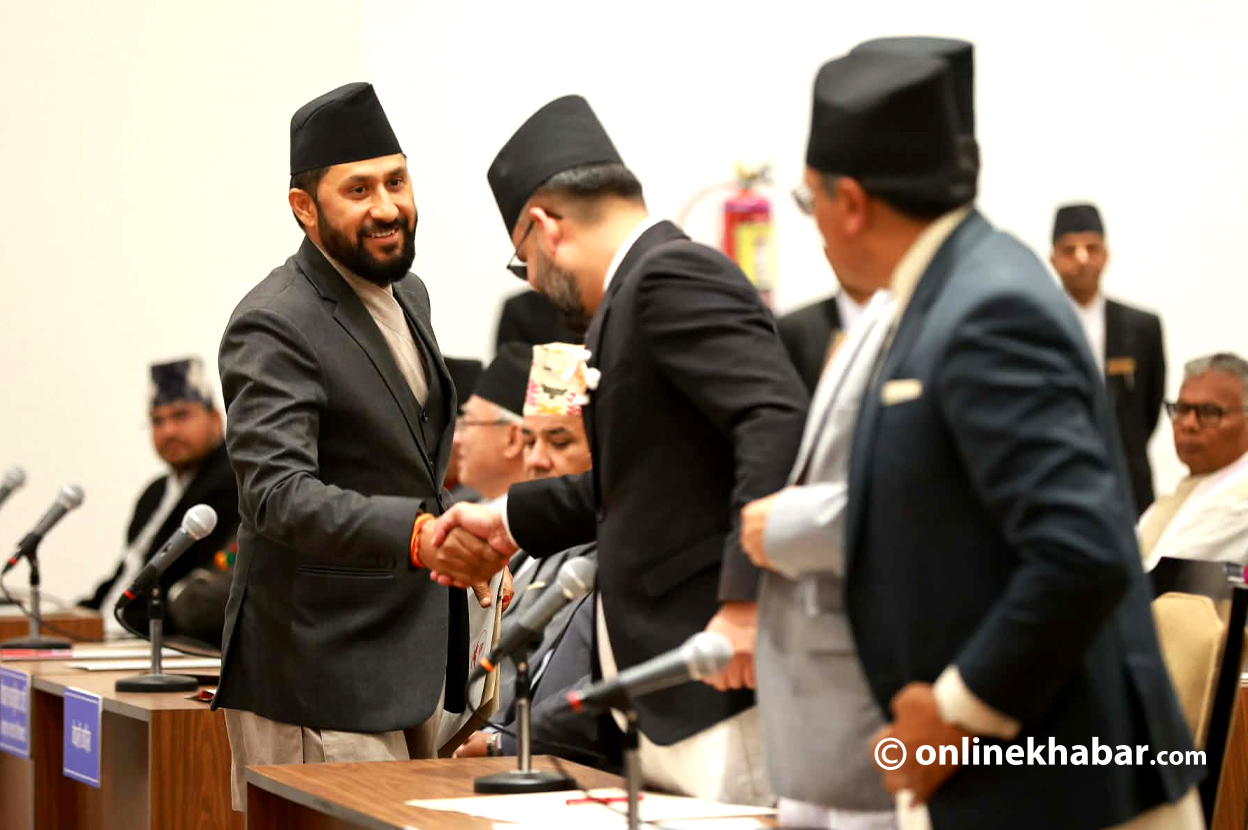
19 Chait, Kathmandu. In the first meeting of the House of Representatives held after the February 21 election, Hark Sampang, chairman of the Labor Culture Party, raised the issue of property investigation. And requested to start it from the incumbent ministers and parliamentarians.
‘Property investigation and cleansing campaign should be started. First of all, there should be an investigation by all the ministers of the Council of Ministers who are currently in the government and we MPs,’ said Sampang.
Thus, while the subject of investigation has been raised since the first day of the Parliament, the members of the Council of Ministers have not disclosed their property details, while the Rashtriya Swatantra Party (RASWPA) has mentioned this in its manifesto.
“Before assuming public office, we will make our property details fully public,” RSVP said in point no. of its election pledge. 16 said. Government reform, corruption control and digital governance have been prioritized by the RSVP.
Ramesh Prasain, co-spokesperson of RSVP, says that they are clear that the property details should be made public.
He says, ‘property details should be made public. This happens. It was a little late because he had just taken the oath. Property details of all ministers and parliamentarians must be made public. According to him, there is a rule in the RSVP that the central members must also submit the property statement. In the case of the central member’s property details, it will be in the party’s Akhilekhra only.
Now, as per the promise of the party, the ministers have not disclosed the property details, but earlier they had submitted the details when they went to the government. On 21 February 2080, when participating in the reconstituted Council of Ministers, all the ministers of the RSVP submitted their asset statements.
Deputy Prime Minister and Home Minister Ravi Lamichhane, Minister of Labor Dol Prasad Aryal, Minister of Education Sumana Shrestha and Minister of Sports Virajbhakt Shrestha submitted their property details to the Prime Minister and Cabinet Office within the stipulated time frame.
Even though there is still time left according to the existing law, RSVP has not yet implemented its own pledge.
According to point number 16 of the covenant, the property details should be made public. Party Vice Chairman Swarnim Wagle, senior leader Balen Shah and others had said while releasing the pledge, ‘This is not just a paper document, it is a commitment to the people.’
What is in the law?
The legal provisions regarding the property details of public officials are guided by the Prevention of Corruption Act, 2059. Section 50 of the Act has made clear provisions regarding the procedure and time limit for submitting property details.
According to sub-section (1) of the Act, within 60 days of assuming public office and thereafter within 60 days of the end of each financial year, it is compulsory to submit updated details of the sources of assets in the name of one’s/family to the designated body.
In the case of ministers, the office of the Prime Minister and the Council of Ministers is the body that submits such details. In the event that the deadline for submitting the details has been exceeded, there is a facility to get an additional 30 days’ time if a reasonable reason is shown.
If someone does not submit the details within the specified time, there is a provision of Rs 5,000 fine as per sub-section (3). In addition, the legal basis is prepared for the authority to carry out further investigation by assuming that the officials who do not provide details in time have illegal assets.
Similarly, according to sub-section (4), the property details submitted by the concerned shall be kept confidential, which can be disclosed only for the purpose of research or investigation.
Although the amendment of 2081 further expanded the scope of public officials and national servants, it retained the old provision of keeping the details confidential. This means that the existing law obliges officials to submit property details to state agencies, but does not make it mandatory for the general public.
Section 31(a) of the Commission for Investigation of Abuse of Authority Act, 2048 has also given the legal right to demand property details from persons holding public office. In accordance with this arrangement, the National Vigilance Center has been collecting details of employees and officials.
In the promise letter of the RASWPA, it is committed to publish the property details before the prevailing law.
However, the Balen government, which has been in ‘action’ since the day it was sworn in, has not implemented the said promise. It has been 7 days since the formation of the 15-member cabinet. The tenure of MPs has already started.
In the government’s 100-point agenda, there is also an announcement to form a committee to investigate the assets of public officials and high-ranking employees since 2048. However, for this, the opposition parties argue that the property details of the incumbent minister should be made public first.
Chairman of Shram Sanskriti Party, Sampang has also written on social media that the decision to investigate the property is welcome and the government’s program should be implemented fairly.
‘Property investigation should be initiated by the Prime Minister. The Prime Minister should start with himself, Ravi Lamichhane and Sudan Gurung,” Sampang wrote, arguing that the property details should be made public. Where is the investment? The source of all those things should be revealed. When a rule is imposed, it should start from oneself.’
Clause No. 16 of the pledge does not only mention the disclosure of property details before holding public office. It has also been promised that the details will be published again after the completion of the term.
“Before the elections and after the completion of the term, we will conduct an independent audit and make it public to the public about how much has changed in our and our family’s assets,” the pledge said.